Showing posts with label Art. Show all posts

Tuesday, August 06, 2013

Unicorns and other creatures

Part of the Cloisters Unicorn tapestry

While reading the classic King of Elfland's Daugher, by Lord Dunsany, I came across the unicorn, again. It figured prominently before (or rather after) in Neil Geiman's Stardust, and got me interested in the subject. That is why, while in NYC, I decided to go back to the Cloisters museum and check out their famous tapestry as well as the current unicorn exhibit all over again.

It was interesting to learn that the horns of the unicorns became very popular relics during the Middle Ages for kings and churches to keep. They were actually the tusks of narwhals, arctic whales not familiar to the Europeans then. These tusks grew from 1.5 to 3 meters in length and served as the artifacts justifying the unicorn legend over the years. In medieval times, believed to come from the unicorns, the tusks were said to cure poison and melancholia, and provided a great trading opportunity for Vikings, that bought them from Inuits, and sold them to crazed European monarchs for a small fortune.

Cloisters, a beautiful part of the Metropolitan museum in New York, hosts the Unicorn tapestries, the gift of John Rockefeller. These are seven tapestries telling a surreal story of the hunt for the unicorn by adrenaline-filled hunters - a vivid reminder of the scenes from the Lord Dunsany's novel. Although mentioned by Greeks, Jews, and Arabs, Christians have been interpreting unicorn as a symbol for Christ's suffering, and that is one of the possible allegories for this particular tapestry. An enchanting visit!

Enjoying the "art minute" at the Cloisters

Monday, June 10, 2013

Almost there, still here


A Magritte in the making, Swedish photographer Erik Johansson's work made me look twice.  Check it out here!

Friday, August 10, 2012

Nostalgic taste of the US

Going to the MFA in Boston has woken up my nostalgia, reminiscing in the impressionists room in front of the Renoir's Dance, Monet's Peupliers, and Degas's Little Dancer.

The new, as always, impregnates the old.  Thus, MFA has built a new wing of American Art in my absence, to now proudly display several works by Sargent and Whistler, among others.  There is this portrait of daughters of Edward Boit, inspired by Velasquez or Degas, and accompanied by real-size vases donated by the family, now actually present in the room.  Loneliness but also magic transpire through the picture and make it a memorable object in the collection at the first sight.


And then the Capri landscapes with Rosina, the all-time classics, as always, beautiful and full of movement.  Dance, now immortal Rosina, dance!


Thursday, September 29, 2011

Traveling light...

Wall in Figueres

when god lets my body be
from each brave eye shall sprout a tree
fruit that dangles therefrom
the purpled world will dance upon
between my lips which did sing
a rose shall beget the spring
that maiden whom passion wastes
will lay between their little breasts
my strong fingers beneath the snow
into strenuous birds shall go
my love walking in the grass
their wings will touch with her face
and all the while shall my heart be
with the bulge and nuzzle of the sea
(e.e.cummings)

Tuesday, July 12, 2011

Edinburgh the gloomy

Continuing my travels up North, I also visited Edinburgh, the Scottish capital where I have not set my feet yet.  During the visit itself I started to dimly recollect talking about the city, its history, and sights, in our English classes in high school, long time ago.  A very interesting city indeed that generously provided for a surprisingly rich visit despite the unpredictable uncontrollably rainy weather and limited time available for sightseeing.  One has to be warned directly and honestly - visiting Edinburgh without rain is possibly impossible in summer.  But it has some ways to keep the tourist happy - such as numerous museums, shops, or coffee houses (such as this one, the Elephant House, where for instance Harry Porter was born among other novels, scribblings, and journal entries by the tea, coffee, and elephant lovers).  At the first sight, it appears a gloomy city indeed:

Greyfriars Churchyard

One of the sights I did have a chance to visit was the Holyroodhouse, the Edinburgh residence of the Queen. Rich in history, it was home to many Kings and Queens, most memorable probably being Mary Stuart, that saw her lover killed in one of the rooms here by her husband (yes, many gloomy stories in Edinburgh)...

Inside court of the Holyroodhouse
Outside the palace, actually alongside behind it, lie the ruins of the abandoned abbey that inspired Mendelssohn's Scottish symphony among others.  Roofless and open to the sky, defenseless in Scottish weather, the walls still proudly stand, a symbol to both the permanence, and impermanence of things.  It also made me think of the speech by Deirdre McCloskey I heard just a couple of days before about the Victorian travel writer and skeptic Alexander Kinglake, who suggested that every church should bear on its front door a large sign, "Important If True..."

Romantic remains of Holyrood Abbey

Although the rain managed to spoil several of the walks in the city during the two days I spent there, the compensation came in the most ephemeral form - the clouds.  Incredible clouds, almost as if painted by Constable himself kept changing, moving in, moving out, all day long. Although often bringing the rain with them, they kept the sky so beautiful, so curiously different at every moment, that it became a delight for me trying to spot the blue quadrant somewhere in the middle of the stormy surroundings.

Clouds over Edinburgh

Oh, and not to forget Bobby.  As Copenhagen has its Little Mermaid as a symbol, Edinburgh has Bobby.  He is the celebrated dog that spent 14 years mourning on the tomb of his master, John Gray, in the 19th century.  I heard that story in some context before, it was funny to come across the statue of the hero in Edinburgh:


To finish with art, the National Gallery impressed me with this portrait of Lady Agnew of Lochnar, by the talented American John Sargent that kept me standing there, apparently it made his fame in the UK, and I am not surprised.  It left more impression on me than Rafael (he could not paint hands, could he?), Titian, or Gainsborough downstairs (maybe Botticelli's Virgin adoring the child also left an impression).

Tuesday, July 05, 2011

Copenhagen, the bike city


Nyhavn, where Hans Andersen used to live for many years

Lately I have been, among other things, visiting Copenhagen, a city that has been on my travel list for at least 10 years now.  Before, I have only been to Oslo, of all Scandinavian cities, although closely acquainted with Sweden during my early days, while learning to read with a book about Karlsson and his travels on the roofs of Stockholm through the incredible imagination of Astrid Lindgren and my father's efforts.

First impression - a city very similar to Belgium, especially the Flemish part, as well as to Amsterdam.  Another strong impression - bikes. They are everywhere!  There are more bicycles in this city than I have ever seen before, probably more than cars, impressive.  It looks interesting, although maybe not exactly always beautiful to see loads of bikes left unattended in all possible places and positions.


Otherwise the city has more space than other European capitals - big streets, unexciting food, and a lot of Anglo-Saxon influence, for the good or for the bad.  Sure, they all speak perfect English here, 7-11 shops litter every street corner, and eating a steak or a burger is the most usual thing.  Maybe Copenhagen is not architecturally very appealing, but one comes to appreciate the harbour, the small houses, and especially the museums.  Danish culture is carefully presented in the National Museum, with expositions including mummies from 1300 BC, originally buried in oak trunks. Strange to see so much interest in home culture - I am more used to French, English, or Spanish museums proudly exposing things stolen from other parts of the world.  Here Danish have done a great work to expose details of their own, warrior Viking roots.  As interesting as Egyptian culture, a good learning moment, especially given that Vikings were also my own forefathers, engendering Ukrainians together with the Mongols that came all the way from the East.

So much available water also afforded us a pleasant boat tour, visiting the city symbol, Andersen's unhappy little mermaid. Despite the happy-end interpretation by Disney, the original fable is rather depressing. The statue has not been very lucky either.  It is actually famous in Denmark because it has lost its head several times since its installation in 1913 by the Carlsberg brewer, Jacobssen, in fame of his lover.  First, the mermaid was decapitated in 1964, and again in 1998, as a protest against consumerism, and as an act by feminists to show that women are valued mainly in the society without heads, body alone.  The statue is still there, with a copy to replace the head that was never found.


To stay with the mood, we also visited the freetown of Cristiania, ideallist town or dirty squat in the middle of Copenhagen.  The sad free town, declared independent in the 1970s, remains just that...sad but supposedly free...


We finished with a visit to National Gallery and happened to see a very nice exposition of "French" art 1900-1930, especially fauvists such as this Anita by Kees van Dongen:


And Derrain's Woman in Chemise


Travels to be continued...

Sunday, April 17, 2011

Miro, painter poet

"For me, a picture should be like sparks. It must dazzle like the beauty of a woman or a poem. It must have radiance; it must be like those stones which Pyrenean shepherds use to light their pipes." Miró

Moon Bird at Smithsonian Hirshhorn Museum, Washington DC

Visiting another exhibition on Miró, I am always enchanted to find his works more surprising, less simple than it might seem at the first sight, always more inspiring, but also more fleeting.  Miró, with his farmer or factory-worker face, looks almost as surreal as Magritte on the old black-and-white pictures.  Is he making fun of us, his audience, painting and talking about these images that find meaning as he paints them, that find their names when he is done throwing paint on the canvass, concentrated, hard-working, all day long?  Or does he know more than us, does he have a different sight, does he talk with Plato's shadows of the ideal?  It is always the woman and the bird that come back in his paintings - not ants like in Dali's nightmares, but constant inspirations for Miro's more poetic and mystic work.  Even during the dark years of WWII he paints women - in black this time. 

One of the discoveries for me during this exhibition in Brussels (where ING is copying Fundacion Caixa in Barcelona with a dedicated space for art in the city center) was a book Miro illustrated for Paul Eluard's poetry.  The illustrations reminded me of Shagal's more spiritual work for the Bible, where here Miro remained Miro - light, easy, un-understandable, full of himself - and full of meaning for the ones willing to accept him as he comes.  Sure, as he and Eluard come together.


Une prison découronnée
En plein ciel
Une fenêtre enflammée
Où la foudre montre ses seins
Une nuit toute verte
Nul ne sourit dans cette solitude
Ici le feu dort tout debout
À travers moi.


Mais ce sinistre est inutile
Je sais sourire
Tête absurbe
Dont la mort ne veut pas dessécher les désirs
Tête absolument libre
Qui gardera toujours et son regard et son sourire.


Si je vis aujourd’hui
Si je ne suis pas seul
Si quelqu’un vient à la fenêtre
Et si je suis cette fenêtre
Si quelqu’un vient
Ces yeux nouveaux ne me voient pas
Ne savent pas ce que je pense
Refusent d’être mes complices


Et pour aimer séparent.
(P. Eluard)

The last impression from the exhibition - this other quote from the artist: "Pour moi, conquérir ma liberté, c'est conquérir la simplicité. À la limite, une ligne, une couleur suffisent à faire le tableau". This made me think more of my thesis - I would wish so much for it to be simple, for me to finally see the light and make it simple, conquer liberty through simplicity...

Thursday, July 22, 2010

Surreal World of Magritte

After experiencing Catalan and Spanish flags through one exciting week-end in Barcelona, my next encounter with nationalism took place yesterday during the celebration of the national holiday in another pretty divided country, that is Belgium.  Coming from the outside as i do, it is usually hard to agree and understand the need for separation and different identity in these seemingly such interesting and culturally rich countries.  Oh sure, yes, there are all the historic, although to tell the truth usually mainly financial, reasons for all the discontent. However, it was somehow a pleasure to see Belgians united for once, partying all together with their army, king, and political elite.  

My highlight was a visit to the new Magritte museum in Brussels, that for the day charged only 1 euro for its, it has to be said rather meek, collection.  Nevertheless, it was very well housed, introduced, and displayed.  Magritte is an interesting outsider to the glamorous life of painters in the XXth century. Held on a short leash by his life-long love with Georgette, he never managed to get full-heartedly accepted into the Paris circle of surrealists, and decided to live in a stand-alone bourgeois mode with his wife and friends in Brussels.  At the same time, he was a prolific artist, and a volcano of imagination and brilliant ideas for his work.  His final success came to him in the US, of all places, although now he is reveered in many an intellectual gathering.  Despite this success, most of his life he dressed like a respected banker rather than a crazy surrealist, the reverse side of the mirror to his flamboyant counter-part Dali.

One of the pictures that impressed me most during this visit was the below Art de la Conversation.  I find it a very good painting, located in that space somewhere in the middle ground between subconscience and the mind, where Magritte situated most of his works.  The two gentlemen conversing manage to build a huge structure, with the dream playing the center-stage, although simultaneously defying the laws of gravity and language.


The other picturte that left its mark on me was this, Domaine d'Arnheim, a theme Magritte followed in several of his paintings in the decade before his death (in 1967), inspired as he was by Poe stories.  Maybe because the paysage looks a lot like the North-side couloir to the left of Frendo spur, and Auiguille du Peigne is so tastefully transformed into the bird trying to get free out of the ice, or maybe because the picture also signals some possibility of hope, birth, life, coming from this austere twilight zone of the mountain.  One way or another it is a painting worth having a thought about:


These ideas go hand in hand with the book I am currently reading, Hofstadter's GEB, and specifically paintings by Escher mentioned there.  Basically Hofstadter talks about inifinite or strange loops, something Escher was really good at showing graphically, for instance in his Drawing Hands below.  The animate is born from the dead matter, hands come alive from pure imagination and lines traced by a pen.  Maybe it is just my mind playing tricks, but Magritte, his Ceci n'est pas une pipe etc. seem to be working on the same wavelength.

Wednesday, May 26, 2010

Art Minute

Van Gogh, so the story goes, used to be afraid of painting faces.  He found humans so strange and inaccessible a species, that he first attempted painting them without taking up the challenge of depicting their facial expressions at all.  In this vein, he obliged himself with a painful and diverse life, working as an art dealer, studying to become a minister in Amsterdam, failing to get a post in the church, living as an independent missionary among the Borinage miners.  Things changed when he discovered color in Paris, where he also met Seurat, Pissaro and Toulouse-Lautrec.  However, color did not help him to sell his paintings, and he committed suicide after managing to sell only one of his works.  The sign of the new times - his work is highly appreciated now, maybe because it somehow keeps us within the illusion of sanity, contemplating Van Gogh that crossed the limit in trying to understand human beings, losing his head in the process, but leaving us with the dowry - his loud and clear, unbounded and imaginative accomplishment.  At the threshold of eternity :


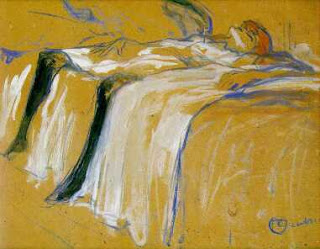
All this was a prelude to post one of my old-time favorites from Toulouse-Lautrec, another weirdo, a product and anti-product of the French culture of the time. Son of an aristocrat, at 12 he broke his left leg and at 14 his right leg.  The bones failed to heal properly, and his legs stopped growing.  His adult height was 1.5m. To escape his handicap, he invested himself wholly into his art and alcohol. He stayed in the Montmartre cartier of Paris, the center of the cabaret entertainment and bohemian life that he enjoyed painting so much. Circuses, dance halls, nightclubs, and racetracks - a new theme for too formal and romantic an art before the loud arrival of this short character. One of his most striking paintings, Alone:


I have been thinking recently about writing a paper on the institutionalization forces within French art development in the 19th century.  It seems to be a nice example of institutional entrepreneurship, where impressionists, such as Monet and Manet, having their paintings refused at the most legitimizing event - the Paris Salon, managed to convince the public during their lifetime about the value hidden in their paintings using alternative Salons and other 'social movement' tools.  Others, such as Van Gogh or Gauguin, simply refused to participate or play the game - and were left out of the legitimate art community.  Thus, the choice within society is either to conform, to try to change the rules, or to refuse to play the game altogether.  The outcomes seem to also be predetermined in a way...

Tuesday, November 17, 2009

Momo

A  mix between Bacon and DeStael, just what i needed for today - Maurice Marechal and his paintings...

Autoportrait, 2005:


L´espoir, 2007:


Saturday, August 22, 2009

Photos by Willy Ronis

While visiting Arles, there was a retrospective there of photography by Willy Ronis. It is the first time i came across his work - and it is incredible.

Place Vendome, Paris:


Or Venice, Foundamenta Nueva:

Or the Nu Provencal, somehow reminding me of my vacation as well, and of Ansel Adams, associated to the last Yosemite trip (even less logically related...) :

More here. Just one more, as i can't resist - Back to School:

Monday, May 11, 2009


Cuando uno se enamora las cuadrillas
del tiempo hacen escala en el olvido
la desdicha se llena de milagros
el miedo se convierte en osadía
y la muerte no sale de su cueva

enamorarse es un presagio gratis
una ventana abierta al árbol nuevo
una proeza de los sentimientos
una bonanza casi insoportable
y un ejercicio contra el infortunio

por el contrario desenamorarse
es ver el cuerpo como es y no
como la otra mirada lo inventaba
es regresar más pobre al viejo enigma
y dar con la tristeza en el espejo

(M. Benedetti)

Monday, February 23, 2009

Cildo Meireles at MACBA


Slowly getting back to art after my hurricane Rome trip, I went to Cildo Meireles expo at MACBA last week. MACBA itself is situated near the Rambla and Plaça Cataluña and represents Barcelona very nicely, a new building fitted into old streets, with nice bars and plenty of skateboarders around, reminiscent of my youth rollerblading around Palais Royal in Paris. But those old days are gone and no crying about it will do any good. Sometimes commitment, or burning all bridges, reducing freedom makes us more free - or at least that is what i want to believe with my climbing attitude today.

Back to the original topic, Cildo Meireles is a Brazilian, traditionally following the post-modern art principles: unimpressive works, worth three descriptive paragraphs in a booklet and one bored look. However, fortunately, his other works are more interesting. The ones i liked most was his Eureka, maybe for its participative mode and some thinking required, the anti-colonial Como Construir Catedrais, and the what we called the "Green Room", also interesting conceptually and aesthetically.

For me, if an artwork is not aesthetic, it looses a part of its original appeal - I am probably conservative in this respect, but i cannot admire something that is not aesthetically appealing as well as conveying a message. That is one of the reasons many post-modern works appeal so little to me and my dumb aesthetic standards. But Cildo managed to surprise, thus a visit that is worth your time! Pictures of his art are definitely not very representative, as his work has to be seen to be understood and to give you the surprise factor, thus i will stop my musings here and let you visit an expo instead!

Friday, December 19, 2008

Firenze the Artsy


Florence in a day is a marathon task, even in winter and without crowds in the museums! I started at 8 am and was running until 7 pm non stop, with just time for a coffee and an ice cream, and still, there are things i wish i had time to see (like the Medici mausoleum, Santa Trinita church etc.)!


The list of my favorites is long, and please don't forget i only had a day to spend there, running literally from one place to another...:

- San Marco monestary with cells painted by Fra Angelico (Beato Angelico), in the style of the Annonciation below that greated monks as they went to their dormitories. Not only Cosimo the Elder of Medici family had his private cells in this monestary, but also the christian fundamentalist Savonarolla lived and ruled from there, until he was burnt by the same city that followed his advice and burnt its books just a few years earlier...(see last novel by Salman Rushdie, the Enchantress of Florence for more historic details and interesting interpretations)


- Bargello and the newly restored David, the second David in Florence, by Donatello this time, along with Jean the Baptist and the most impressive of them all, the wooden Magdalena statue at the Duomo Opera not to miss:


- Brancacci capella decorated by Masacio between 1425-1428, the inspiration to the Renaissance to come. As Da Vinci said, the first real painters were Masacio and Giotto. Unfortunately Masacio died at only 27, Brancacci capel being his masterpiece to the world. His Adam and Eve expelled from paradise can be seen as inspiration for Rennaissance - or even Munch, closer to us:

- Gioto's cross at Sta Maria Novella

- Uffizi and its Boticelli, who with Michel Angelo later and many others was welcomed by the Medici family, ate at their table, and painted their portraits.

- Palatine Gallery housed in the Pitti Palace, originally planned by the Pitti family who went bankrupt during the construction process. Eleonore de Toledo, married to the Medici, bought the palace for the rival Medici family and transformed it into the royal habitat where the last Medici died in the 18th century, bequesting all the art works to Florence. Thank you, Anna Maria Louisa for this priceless gift! My favorite in the museum was the below heavenly Madonna by Rafael:


Otherwise, more down to earth, Florence boasts numerous nice places for hot chocolate and sandwiches - for instance Ino' near Uffizi, and very good ice cream joints for any taste.

Wednesday, December 17, 2008

Rome Galleries

Rome is, without a doubt, a very rich city in art, especially its various galleries and Palazzios. My favorite ones from what i had time to explore follow:

If you have time for only one, definitely go to the Borgese Gallery. It is situated in a calm and romantic garden, and preserves incredible works, especially several statues by Bernini, the inventor of Barocco, and the third genious Italian sculptor in the direct Donatello-Michelangelo line.

One has to see Daphne and Apollo to believe it. It captures the moment when Daphne is transforming into a tree while still being chased by lustful Apollo, the picture hardly represents the life-like, pure emotion syrup:


And this view of David in motion:Another rich Palazzo-museum is the Capitolian one, situated on Michelangelo's Campodoglia, the perfect plazza. It is full of Roman and Greek statues from various excavations, and is itself situated where the old Jupiter temple used to stand on the Capitolian hill, the center of Roman civillization. The museum also beholds the bronze statue of the wolverine that supposedly fed Romulus and his brother Remus in their infancy, before they founded the eternal city.


Another interesting visit has been to the Medici Villa and its gardens. They are only accessible on specific times as it is still the residence of the young French Rome prize winners for art. The villa is situated on another hill, close to the Plaza de Spagna, with very beautiful views of the Rome panorama, but also incredible gardens:
It is easier to understand seeing these gardens how painting would start incorporating perspective into its quarters. Numerous French artists lived in the villa, such as Debussy or Berlioz, Ingres was its director for years, Velasques painted the below arch in his paintings several times. All of these references, and a knowledgeable guide speaking both, Italian and French, make the garden visit a must for the art-inclined.

Bellini expo at the Scuderie de Quirinale is worth a glimpse - it highlights the artist's journey from Messina's influence to the final mastery, as with this Christ with the cross from the Isabella Gardner Museum:


and the Pieta:


I also enjoyed Barberini Palace and its Carravagios as well as the Colonna gallery (only open on Saturday mornings), still reserving its very beautiful decoration and marble floors for the curious souls. Less impresive, although possible visits are the Spada, Corsini, and Venezzia Palazzos, all full of further works of art.

I did forget about the ancient Rome here, but there were just too many museums to see...to pay tribute to the Romans, here we go:


Oh, and Merry Christmas to everyone: