Showing posts with label Travel. Show all posts

Monday, March 24, 2014

Climbing in Wadi Rum

My last time in the desert was in 2005, when I spent a couple of weeks in the Red Rocks in the US. It was also spring, the flowers were blooming, and the climbing was new and good to me. Desert remained a fascinating place, and I have been wishing to go to another desert, Wadi Rum, for some years since. Finally, although with a few difficulties, it worked out this year.

Wadi Rum village

Wadi means a valley in Arabic, thus the Rum village is situated in the middle of a valley between several impressive walls to its sides, with both better or worse rock depending on color and the erosion patterns. Getting there involves flying to either Amman or Tel Aviv, then taking the bus or taxi to Eilat/Aqaba, and then another taxi to Wadi Rum (25JD). The ride already gives some idea of things to come. 

Wadi Rum at night

The village is rather poor, resembling many other third-world countries, with children chasing travelers practicing the recently learnt "hello" and asking for spare dinars. Religion keeps people in check - whereas alcohol is not allowed, tobacco is highly used and overused. The local saying has it that smoking is good for the heart. Cars have replaced camels as the most efficient transportation system in the desert, Toyota enjoying the lion's market share of this market.

Toyota, the new camel

Several routes are popular with the climbers here, the biggest challenge being the loose and friable sandstone. The quality of the rock is very variable, so one has to decide all the time which holds to take and which ones to avoid. It is also dangerous to climb after the rain, as rock becomes softer and protection does not hold. I hear in sandstone areas in Germany it is illegal to climb for at least a day after the rain. Similarly in Red Rocks the saying was to wait at least 3 days after a heavy rainfall.

Approaching the Beauty

Unfortunately for us, this March was unusually rainy, with over 10mm falling in only two days we were there whereas the monthly average for March is around 5mm...We had to wait out some days and do other touristy things while it rained - and even snowed - around us in the desert. That explains the green colors surrounding some pictures. But finally the sun came out and climbing did happen.

Still approaching the Beauty

The Beauty is a duly famous route not only for the climbing, but also for a wonderful and tricky approach to the route. The route finding is not always trivial, and takes you through intricate labyrinths of slot canyons inside the sacred mountain. It is nice enough to make mistakes of the route finding fun and exciting experiences of their own.

When finally reached, the wall is very impressive, with the best rock of the trip for us. Every piece of protection looked solid and inspired confidence, not the usual with Wadi Rum climbing.

Up the perfect rock of the first pitch of the Beauty

Varied crack-climbing went from pleasant on the first pitch, to awkward on the second, to this perfect crack on the last.

 The last pitch of the Beauty

In the Wadi Rum village we stayed with Ali Hamad, who provided us with bed and board, and took care of our travel needs around the desert. While his wife cooked us all possible variations of rice, he drove us with an easy hand to the Barrah canyon and the Nassrani wall. Good place to stay if you are not willing to rough it in the Rest House.

Ali driving through the desert

Barragh canyon is popular with climbers due to the relatively good rock, and we enjoyed climbing the Star of Abu Judaida there as well as the first pitches of the Merlin's Wand. Crack climbing skills are very useful on both.

 Close to the top of the Star of Abu Judaida

The highlight of the trip for us was the Guerre Sainte, or the Jihad route, going up the Eastern Nassrani Wall - in the middle-left of the picture below, close to the black streak (that becomes a waterfall in case of rain) on top of the white wall. Opened by Arnaud Petit, it is a face-climbing jewel of the desert, with relatively solid rock and bolt protection all the way up.

Nassrani Wall

Bolt protection does not mean relaxed climbing though, especially on the seventh pitch, which has a sling and two bolts protecting the crux lower down, and another two bolts and a couple of slings for the remaining 30 meters...

 Up the Jihad

 Climb or go home pitch, Jihad

The route is gorgeous though, with hanging belays most of the way, and vertical to close to overhanging climbing. Only the rock quality could be better, although the last three 7a+/7b pitches have perfect rock and great protection, very welcome after the first 8 pitches involving more fear about the gear and rock. Colors and ambiance are hard to beat.

 Up on Jihad

Overall, an interesting destination, with several things to offer for both culturally inspired travelers as well as sensation seekers. A lot of care is recommended though, as rock quality remains the biggest issue for the area, and especially for weak-headed climbers like me it is hard not to get scared on most routes, whatever the grade.

Rainbow over the desert

Sunday, March 23, 2014

Old Cities of the Middle East - Petra

Another visit, another old city - this one not inhabited anymore, but still shining with its thousand colors in the morning and afternoon sun of the desert. Petra, the most visited attraction of Jordan, is definitely on par with other old sights of human civilizations such as Machu Pichu, Angkor Wat, or the pyramids in Egypt.

View on al-Khazneh


The first sighting of Petra's treasures comes from the Al-Siq slot canyon, one of the old access roads to the city - obviously easily protected. Nabateans chose Petra as their capital for its strategic positioning, but also a rather hidden location in the labyrinth of the sandstone towers. Romans managed to conquer Petra, as well as Jerusalem, and the city started to decline since then. It was lost for many centuries in the sand until a Swiss traveler stumbled upon it again in 1812 and reminded the Europeans of its history.

Al-Khazneh in all its beauty

Petra is an interesting melting pot of cultures and peoples, today as well as yesterday. Greek and Roman architecture had a clear influence on how the temples of Arab gods and the tombs of the gentry should look like. At the same time, the local multicolored sandstone set its own rules of shapes and carving. The city is also an example of ingenuity for water preservation, Nabateans creating an oasis in the desert by building countless canals and cisterns to store water from the rare rains in their mountains. We actually had the opportunity to see Petra wet and to walk through the Al-Siq half-flooded.

Royal tombs (wet)

Today, a few Bedouins seem to live in the caves around Petra, offering donkey and camel rides to the tourists, as well as some tea to the tired ramblers. Usually subdued and dark, once in while it is possible to see a sign of the wild, a sign of power and pride in the corner of their eyes. But then, they lower their heads again, and say "welcome to Jordan".

Al-Siq

Standing at the top of the mountain near the Monastery, one can see all the way to the West Bank and Gasa, ancient prosperous port, deadly zone today. Only imagination can help visualize what has been, what might have been. Reality is different, the ruins are silent, and the children of Nabateans ramble the desert lands in poverty, Toyotas substituting the camels, tourists substituting the spice trade.

The blue columbs of the Byzantine church

Thursday, March 20, 2014

Old Cities of the Middle East - Jerusalem

When travelling through the Middle East, Jerusalem is an interesting experience to say the least. The highlights of Israel include great food and pleasant climate. We ate the best humus ever in the old city, as well as enjoyed incredible vegetarian meals in Tel Aviv. The low-lights include all the armed men and women walking the streets with big guns and few years of experience to justify the responsible use of these guns. That's the price to pay for "coming back home," but the societal impact of having every young member of the society spend three years in the army (two years for women) might not be only positive I imagine.

Coming back to Jerusalem, this famously disputed piece of land is curious to say the least. We entered the old town through the Damascus gate, and ended up in a big souk. A city divided into four quarters, Muslim, Christian, Jewish, and Armenian, is full of smells, merchants, tourists, and religious people. The old city has a very high concentration of religious buildings - churches intermingling with mosques and synagogues. Impressive how the co-habitation has been at all possible in such close proximity here for many years, sad on the other hand that the real peace has not been found by so many deeply religious people. Jerusalem is "too close to god" for its own good, as said our tour guide. 

Dome of the Rock

The most beautiful building in Jerusalem, also said to be one of the oldest buildings of the Muslim architecture still standing, is the Dome of the Rock, above. It was the king Herod (although of disputed Nabatean origin) who built the esplanade to improve Jewish Second Temple and make it worth the admiration of the whole region if not the entire Roman Empire. After the destruction of the Temple, all three religions (Jewish, Christian, Mulslim) kept calling their own different sacred places of the city, but especially the Temple Mount and the Olive Mount.

 Women in front of the Dome of the Rock

The Western Wall, the base of Herod's esplanade for the Second Temple, has emerged over time as a sacred place for the Jewish people, where one can get closer to god, leave him a wish to realize, complain about the past, or dream about the future. The present is special though, with the left side of the Wall only accessible to men, and the right side reserved to women, supposedly based on the distinctions made in a synagogue. Apparently, it is better to talk to god in company of the same sex...

 The Western Wall

Today, since the last Intifada, the entrance of the Dome of the Rock has been prohibited to non-Muslims, another sad sign of the times, although living side by side, no agreement has been reached in this saintly city.

Children playing ball

Still, children kick the ball - however they are already separated by the quarters, Muslims playing with their own, Jewish keeping to themselves. 


The worst impression of Jerusalem we got while driving Eastwards to the Dead Sea through the West Bank. In the distance, one could barely see the Palestinian territories, separated by a wall, a religion, by economic sanctions. Remembering my earlier visit to Osventsim, the question remains - have we learnt anything? Will we ever learn? 

Tuesday, August 06, 2013

Unicorns and other creatures

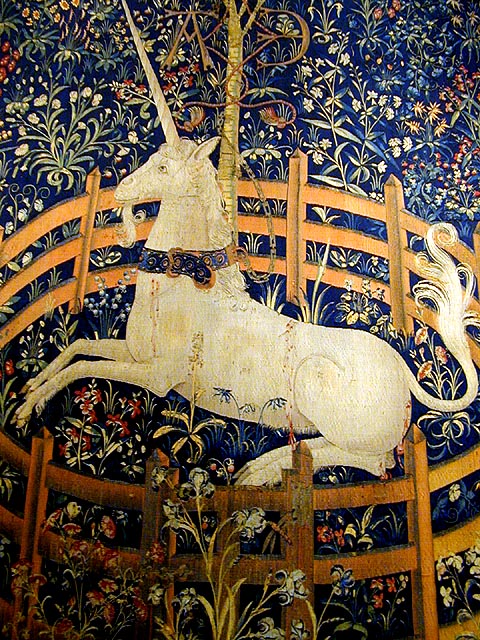
Part of the Cloisters Unicorn tapestry

While reading the classic King of Elfland's Daugher, by Lord Dunsany, I came across the unicorn, again. It figured prominently before (or rather after) in Neil Geiman's Stardust, and got me interested in the subject. That is why, while in NYC, I decided to go back to the Cloisters museum and check out their famous tapestry as well as the current unicorn exhibit all over again.

It was interesting to learn that the horns of the unicorns became very popular relics during the Middle Ages for kings and churches to keep. They were actually the tusks of narwhals, arctic whales not familiar to the Europeans then. These tusks grew from 1.5 to 3 meters in length and served as the artifacts justifying the unicorn legend over the years. In medieval times, believed to come from the unicorns, the tusks were said to cure poison and melancholia, and provided a great trading opportunity for Vikings, that bought them from Inuits, and sold them to crazed European monarchs for a small fortune.

Cloisters, a beautiful part of the Metropolitan museum in New York, hosts the Unicorn tapestries, the gift of John Rockefeller. These are seven tapestries telling a surreal story of the hunt for the unicorn by adrenaline-filled hunters - a vivid reminder of the scenes from the Lord Dunsany's novel. Although mentioned by Greeks, Jews, and Arabs, Christians have been interpreting unicorn as a symbol for Christ's suffering, and that is one of the possible allegories for this particular tapestry. An enchanting visit!

Enjoying the "art minute" at the Cloisters

Friday, August 02, 2013

Lofoten Adventures

This year's visit to the North lands of this planet included sightseeing of Lofoten Islands after some climbing in Sweden.  I first heard of the Magic Islands when living on the East coast in the US, when listening to the folk stories about various adventures of the local Ed Webster, who wrote the first English-speaking guidebook for the area and spent a couple of summers exploring the Northern granite.

Moskenesøya island

After a long and rainy drive (road connects the islands to the mainland through several tunnels, achievement of Norwegian public investments), our first stop was in Henningsvær, a small fishing village at the end of the world. Although it was raining cats and dogs, the village still preserved its charm, drawing unabashed on the climber population due to the climbing school and shop being located in its center. We had some coffee and ate the very expensive cinnamon buns, one of the favorite desserts in Scandinavia, that helped keep our spirits up that first rainy and cold day.


Rainbow after the rain, on the way to Henningsvær


View on Lillemola island from Henningsvær

Sunset over Henningsvær bridge

When wondering through Henningsvær, and after admiring the old Volvo sports car (supposedly the proud property of the climbing shop owner), we came upon Pobel's graffiti on one of the walls. Not much is known about this shadow-painter, except that he lives in Norway, and his name translates to "hooligan", or part of the plebs. Depicting fishermen seems like one of his favorite themes:

Pobel, "In cod we trust", in Henningsvær 

Despite the hopeless downpour on the first day, the weather cleared up and we started climbing the day after.  Although the horror stories of rain on Lofoten I have heard have been many over the years, we were very lucky to hit a high pressure system for over a week during our stay.  We used the days well on the beautiful granite of the islands, starting with the classic West Pillar on the Priest:

Leading up on the Priest, West Pillar

We continued with more climbing on the Priest, and around Henningsvær, exploring the Spring Wall in particular. There, Jonas tried the very hard 7+ finish variation to Blod eller gul, and I enjoyed very much the Gaukerisset crack.

Jonas following the incredible 3d pitch of the Crusade up the Priest

After the tame Priest experiences we decided to go West, towards the less explored territories of the Moskenesøya island.  It is one of the least developed islands in the archipelago, where several inland villages can only be reached by boat.  It is famous for its Bunes Beach, that can only be accessed with a 40-minute hike after taking the ferry to Vinstad from Reine, and is one of the more scenic Norway beaches accessible only by foot.


 Departing ferry from Reine to Vinstad.

Unfortunately, we never reached the actual beach despite all the fame and excitement about it.  On the way to the beach we decided to climb a nice-looking wall towering above Vinstad, with one known route reported in the 2010 update to the Lofoten guidebook.  However, after a longish approach (definitely not 30 minutes...), the first pitch spooked us with its water and grass enough to renounce on the rest and turn back. On the way down the slope, my leg slid through some rabbit hole, and although I did not disappear under the earth following the white rabbit, my ankle decided to twist itself in a painful way as a punishment for all my whining about carrying the heavy backpack.  After finishing the even less pleasant descent, we decided to camp there and then, and not continue the exploration of the island further.

Continuing in the same vein, we woke up at 3:45 am the following night, when Jonas suddenly realized that he did not hear the creek anymore.  It took his sleepy brain a couple of seconds to realize that the creek was not flowing downwards toward the ocean anymore...because we were in the ocean!  Fortuna has struck again, as Ignatius J. Reilly would repeatedly say, and the high tide got the best of us and our gear. 

Ocean at our door.

After this adventure, we decided the island was cursed and did not wish to push our luck further there. After a cold and wet morning spent drying out gear, washing camera and cams in the fresh-water creek, and praying for the electronics to start working again, we turned around, and came back to the more known lands around Svolvær, going to the Paradiset area for some single-pitch fun, Jonas climbing the classic Butter Arms, and me trying out the Svenske Dihedral and the Dosethrisset crack. Apparently, the lines opened by Hans Cristian Doseth have a seal of quality upon them, as he was one of the best Norwegian climbers of his time, with a very good eye for impressive cracks. He died in 1984 on the rappels after establishing the Norwegian Buttress, first route up the East Buttress of the Trango Tower.

Paradiset view towards the open sea

We finished our stay with a long day first trying the Ormen Lange route on Kallebukta, then climbing the very recommendable Pan route on Geitvika buttress, and then finishing with Running for Rasmus on Store Festvag.

Logistics tips for Lofoten

Norway is an expensive country, thus usually climbers are advised to come prepared - i.e. bringing the full provision of food from the less expensive neighboring Sweden is a good idea.  It is possible to camp at several places on the islands free, the rule in Northern Norway being that you can put up your tent anywhere, as long as it is not visible from the nearest house.  There are paid showers at the climbing school and the paid campgrounds.  Wifi is scarce, it is available free at the library at Svolvær.

The weather is the biggest challenge and unknown, as it can rain for several weeks in a row, although high pressure systems are not unheard of, and those can last for a week or two, with full sunshine and t-shirt climbing on the menu.

Climbing is mainly trad climbing on granite cracks, similar for instance to Chamonix, although not much red granite is around.  There are a couple of spots with sport climbing and bouldering, but those as a rule are not the main objectives for climbers on the islands.  There are several quality routes in the guidebook, although there is a certain lack of routes in the higher grades (7b and higher).  The original Rockfax guidebook contains several errors, somewhat corrected by the 2010 supplement.  Especially beta about gear is not totally correct, although sometimes even the lines are drawn wrong...or even drawn on the wrong mountain (!).  There is a folder with the new route updates in the climbing bar in Henningsvær, although it is rather thin given the expense of rock available.

There still seems to be an abundance of possibilities for new routes - although usually a long approach might be involved.  Many routes might stay wet even after several days of sunshine, especially if overhanging cracks are involved.

Most pictures by Jonas.

Thursday, July 18, 2013

Summer in the North

After experiencing the Spanish heat for several weeks and complaining about humidity, we have moved North, and now complain about cold and rain instead.  Northern Sweden is very different from the South indeed, it has its own beauty and personality.  Water (which unfortunately also means mosquitoes) and trees are abundant, making the scenery beautiful and reflective.  

Slow sunset over the Golf of Bothnia, picture by Jonas

There is also climbing in Northern Sweden, although not so well-known as the rock in neighboring Norway.  As Jonas works on the new version of the guidebook for the area, we visited several crags around Lulea, such as the famous Niemisel, claimed to be one of the best sport climbing crags around here, especially for the climbers getting into the 8th grade, visited by both Swedes and Finns of the North.

 Jonas pulling hard in Niemisel

I found Niemisel rather hard, slopy, and overhanging, not to mention wet, for the first visit.  It is another of those places one needs to get used to, requiring patience and motivation to stick to it. Lacking both for the moment, I enjoyed the sunshine and took some pictures instead.

A different Jonas enjoying summer climbing in the North

While in Sweden, I was treated to the classic of the Northern Swedish cuisine, Surstromming.  It is fermented - or rotten - herring, that smells very very bad when the can is opened.  Several stories circulate about unknowing foreigners opening the can and being more than surprised by the unpleasant result.  The taste of the rotten fish is mainly salt, and having practiced with French cheeses before, I successfully passed the exam and enjoyed this special food.

Rotten herring, a "delicacy" of sorts, picture by Jonas

More to come about Northern climbing, hopefully in Norway, if the rain lets us, soon.

Friday, December 28, 2012

Swedish Christmas: God Jul!

I have celebrated Christmas in several places over the years - singing Koliadu and eating kutia in Carpathian mountains with the grandmas, opening up presents from a big red-hooded man and eating oysters, fois gras, and caviar in France with my mother, freezing by myself at the Monchsjoch Hut during my crazy solo stunt in the Bernese Oberland.  Different ways, moods, and aspirations.  This year it was time for something new again.

Jonas's family farm in Boviken, lived in for eleven generations

In my never-ending quest, I ended up up North this year, all the way in Sweden for this celebration. A beautiful winter tale for me, white Christmas, full of discoveries, new tastes, and inspirations.

One of the discoveries concerned the Swedish food - it is very good indeed, especially during this time of the year when stomach is celebrated as the center of the universe, the hero of the day.  I appreciated especially the fish very much, discovering such dishes as Johansson's temptation (Jansson's Frestelse with anchovies); a variety of herring preparations; Swedish orange-colored variation of caviar called Löjrom harvested in the Bothnian bay, and best tasted on the Ljusugnsbröd with cream, onions, and avocado bytes.  There is also the Röding, the best fish ever, also called arctic char, and not to forget gravlax, or raw salmon cured in salt, sugar and dill.  The word actually comes from the mix of grave and laks, salmon, as in the Middle Ages Nordic fishermen used to preserve the fish by burying it in sand at the seashore.  A similar dish, called lox, was popularized in New York by the Ashkenazi Jews in combination with cream cheese and capers.


Pickled herrings at the Stiftgarden's Julbord

All of these goodies can be tasted at a Smörgåsbord, or a buffet served at a restaurant or at people's homes with first a self-serving of cold fishes, then of meats, and then sometimes of warm food as well.  For Christmas, Smorgasbord becomes an even richer Julbord, usually started with bread dipped in ham broth (hard to really appreciate for not properly initiated foreigners like myself), that then follows the normal fish/meat/cheese/desserts order.  And yes, never to forget the desserts - in Sweden very well accompanied by various berries of the land, starting with the more well-known blueberries, raspberries, and black currant, then venturing into the unknown territory of Hjorton and Åkerbär that go very well with ice-cream, cheesecake, or a parfait, in color and in taste.

And if you are tired of cooking, invite guests for a tea or gluhwein or glögg ceremony, where gingerbread can be served with Philadelphia cream cheese and the ever-present lingonberry to everyone's delight.

Glogg and tea-time at Lindbergs'

The actual Christmas celebrations started with a sermon on the morning of the 24th, to be continued by watching Donald Duck at 3 pm - what I am being told is a very important Swedish tradition going back to the times when the first TVs were adopted by the households here in the 50ies.  And what Christmas could happen without a Santa, especially here up North, supposedly one of the places where he actually might live?  All three of them arrived to our house on...a snow-mobile (how else?!) and dutifully delivered all the presents except one still to come...:( (damned post office).

3 Santas delivering presents in Boviken

After having snowed for every day in Umea and Skelleftea since December 2nd, the weather finally changed for a day, and allowed us to go for a skiing trip with not-so-cold temperatures to Bygdsiljum.  The best Christmas gift happened when the sun came out to provide us with the much-needed Vitamin D and the beautiful views on the pine trees and the valleys below.

Mid-day northern sunset at Bygdsiljum

And the moon rise soon afterwards


Merry Christmas and Happy New Year to all from the North :)


All pictures (and inspiration) by Jonas Wiklund.

Wednesday, October 10, 2012

Prague in pictures

This is the result of two hours of free wondering and improvisation around the old city, oh so similar to my own old memories of Eastern Europe.  My old camera and some strange software on my PC seemed to make sense out of the strange bunch of my pictures and some skills acquired here and there - especially thanks to the advice by Jonas.


This last set of pictures is from a street performance advertising Dulux paint, of all matters...I learned it only afterwards, believing at first that it had something to do with more pressing concerns, such as environment, or other social movements.  But no, corporate branding effort it was, surreal nevertheless.


And to celebrate my photo-infatuation, here is my new Flickr account.