Не жалею, не зову, не плачу,
Все пройдет, как с белых яблонь дым.
Увяданья золотом охваченный,
Я не буду больше молодым.
Ты теперь не так уж будешь биться,
Сердце, тронутое холодком,
И страна березового ситца
Не заманит шляться босиком.
Дух бродяжий! ты все реже, реже
Расшевеливаешь пламень уст
О моя утраченная свежесть,
Буйство глаз и половодье чувств.
Я теперь скупее стал в желаньях,
Жизнь моя? иль ты приснилась мне?
Словно я весенней гулкой ранью
Проскакал на розовом коне.
Все мы, все мы в этом мире тленны,
Тихо льется с кленов листьев медь...
Будь же ты вовек благословенно,
Что пришло процвесть и умереть.
Есенин, one and only...
Sunday, May 30, 2010

Wednesday, May 26, 2010
Art Minute
Van Gogh, so the story goes, used to be afraid of painting faces. He found humans so strange and inaccessible a species, that he first attempted painting them without taking up the challenge of depicting their facial expressions at all. In this vein, he obliged himself with a painful and diverse life, working as an art dealer, studying to become a minister in Amsterdam, failing to get a post in the church, living as an independent missionary among the Borinage miners. Things changed when he discovered color in Paris, where he also met Seurat, Pissaro and Toulouse-Lautrec. However, color did not help him to sell his paintings, and he committed suicide after managing to sell only one of his works. The sign of the new times - his work is highly appreciated now, maybe because it somehow keeps us within the illusion of sanity, contemplating Van Gogh that crossed the limit in trying to understand human beings, losing his head in the process, but leaving us with the dowry - his loud and clear, unbounded and imaginative accomplishment. At the threshold of eternity :

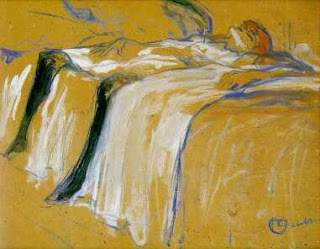
All this was a prelude to post one of my old-time favorites from Toulouse-Lautrec, another weirdo, a product and anti-product of the French culture of the time. Son of an aristocrat, at 12 he broke his left leg and at 14 his right leg. The bones failed to heal properly, and his legs stopped growing. His adult height was 1.5m. To escape his handicap, he invested himself wholly into his art and alcohol. He stayed in the Montmartre cartier of Paris, the center of the cabaret entertainment and bohemian life that he enjoyed painting so much. Circuses, dance halls, nightclubs, and racetracks - a new theme for too formal and romantic an art before the loud arrival of this short character. One of his most striking paintings, Alone:
I have been thinking recently about writing a paper on the institutionalization forces within French art development in the 19th century. It seems to be a nice example of institutional entrepreneurship, where impressionists, such as Monet and Manet, having their paintings refused at the most legitimizing event - the Paris Salon, managed to convince the public during their lifetime about the value hidden in their paintings using alternative Salons and other 'social movement' tools. Others, such as Van Gogh or Gauguin, simply refused to participate or play the game - and were left out of the legitimate art community. Thus, the choice within society is either to conform, to try to change the rules, or to refuse to play the game altogether. The outcomes seem to also be predetermined in a way...

All this was a prelude to post one of my old-time favorites from Toulouse-Lautrec, another weirdo, a product and anti-product of the French culture of the time. Son of an aristocrat, at 12 he broke his left leg and at 14 his right leg. The bones failed to heal properly, and his legs stopped growing. His adult height was 1.5m. To escape his handicap, he invested himself wholly into his art and alcohol. He stayed in the Montmartre cartier of Paris, the center of the cabaret entertainment and bohemian life that he enjoyed painting so much. Circuses, dance halls, nightclubs, and racetracks - a new theme for too formal and romantic an art before the loud arrival of this short character. One of his most striking paintings, Alone:
I have been thinking recently about writing a paper on the institutionalization forces within French art development in the 19th century. It seems to be a nice example of institutional entrepreneurship, where impressionists, such as Monet and Manet, having their paintings refused at the most legitimizing event - the Paris Salon, managed to convince the public during their lifetime about the value hidden in their paintings using alternative Salons and other 'social movement' tools. Others, such as Van Gogh or Gauguin, simply refused to participate or play the game - and were left out of the legitimate art community. Thus, the choice within society is either to conform, to try to change the rules, or to refuse to play the game altogether. The outcomes seem to also be predetermined in a way...
Monday, May 24, 2010
Rodellar, or Egocentrismo Struggles
I am starting to appreciate more and more the overhanging climbing. It impresses me maybe because of my previous alpine experience and the well-established belief about my total inability to climb overhangs. When in Belgium, i struggled with both, the lack of physical strength, but also mental problems any time i tried serious overhanging routes - on toprope - and in the climbing gym (the country being Belgium...). My evolution as a climber has been long and painful - i repeat myself, but it is still hard for me to believe i am leading these incredible overhanging monsters. Even though they are easy by the sport climber standards, labeled 7as and 7a+s in Rodellar's guidebook, for me they represent huge steps on the moon. Gravity does not seem to be the same in Catalunya, and finally the years and years of experience on the rocks and high mountains make me feel a little bit - just a little bit more comfortable on the sharp end. Training hard in the gym accounts definitely for a big chunk of it, however the other part is oh so psychological, and here i notice all the groundbreaking impact of my last year with the new identity - the sport climber.
So yes, out of the eternal hole of my ego, and back to Rodellar - after a conference in Rome, it was a plane, and then a car ride that brought me for the second, and probably not last time to the Sierra de Guarra. The little village of Rodellar this time was overflowing with people, cars, and dogs. We managed to find a spot at the campground, have a bite at the Florentino, and after a due rest start the projects at Egocentrismo. Concentrating on the projects was very good, however not very productive this time. I spent one day giving battle to the appropriately named Porque, supposedly a 7a+ at the Boulder de John, to the right of incredible sector of Egocentrismo. The below pictures are from this route:


After a toprope, i dared myself to a lead. I did give it a couple of decent tries, however the bouldery crux resisted all the attempts. Pau made good of the route at his first try, whereas i remained closed to the dynamic move, however proud of my leads anyway. Below Pau working his next project, Pequeno Pablo - another mega-jug-fest rated an incredible 7a+ in the guidebook, hard 7b for most mortals, comparable in endurance requirements to for instance CalifatoCoach in Margaleff:

As a consolation prize, i managed to go up the near-by de 8 a 14 route on the second try, whereas the inspiration to lead Pequeno Pablo and to send Porque will have to wait for another visit. Egocentric as i am, i stay amazed at myself, and have to look again to believe this image - incredible heel-hooking me on lead, i never thought i would, but there:

Pictures by Pau, great work, and interesting music discovery - Elle Lefant with No Moon.
Sunday, May 16, 2010
Another route, another climbing day...


Spring
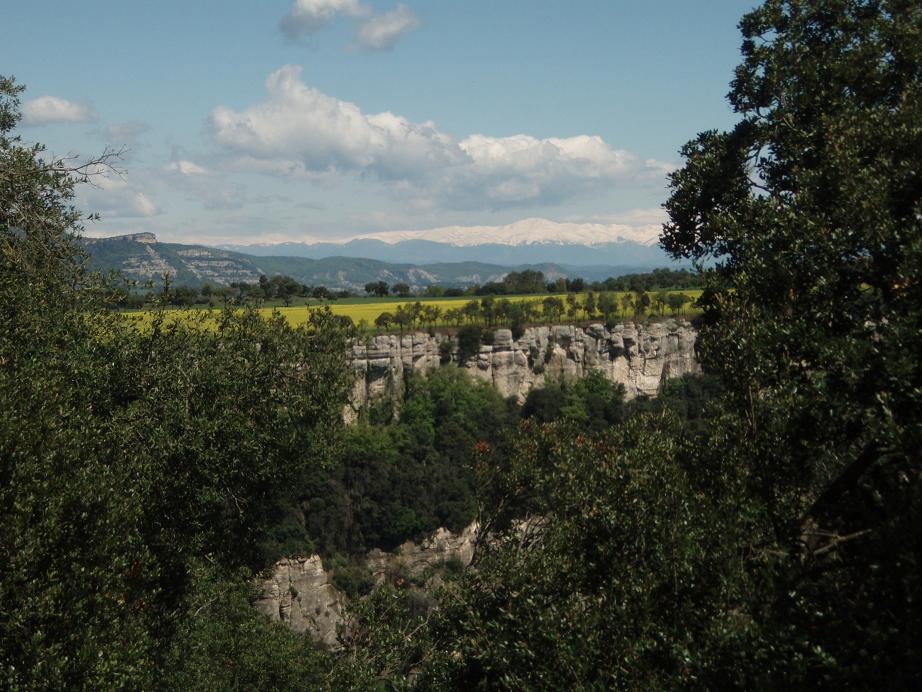
A cloud shadow
A breeze discovered my open book
and began to flutter the leaves to look
for a poem there used to be on spring.
I tried to tell her "there's no such thing!"
for whom would a poem on spring be by?
And breeze disdained to make reply
and a cloud shadow crossed her face
for fear i would make her miss the place
by Robert Frost
Sunday, May 09, 2010
la BuscaBrega, Vermeil

The first time I came to Vermeil it has been a little bit less than two years ago, with Gabriel, another of the guys I meet at random on the internet when looking for climbing partners in a new place. I believe the plan was via larga, the Aranya, but finally we ended up sport climbing, and he showed me Cara Sur of the Mother Mountain. We walked the walk and did a couple of 5s and 6as to the left of San Agustin. Then he told me there was this awesome 6b, pretty hard but awesome, technical, dihedral climbing. I went for it, and onsighted the climb, the highlight of my day and probably week during those dark ages of my climbing career.
It was the time when I was starting to recover from my mountaineering adventures and painfully taking up the sharp end again. Coming of age, one might say - after the too quick beginning and end of an alpine career, I arrived - at least for some time. I arrived to the climbing paradise on this planet, the little province of Catalunya I continue enjoying in rain, snow, and mainly good weather. I started my recovery journey climbing long, epic, and fun routes with Cathy - and in the end of the circle have arrived back to where it all started, the sport climbing, the measured head, the technique and the flow.
Vermeil has become second home by now, two years later, especially after numerous thoughts about moving to El Bruc. After working the Vianant for some time and having trouble reading the crux move there, I decided to change the objective to the near-by BuscaBrega, another route with some fame for being hard and contrived. Although some people say it is 7b+, such as Luichi and his guidebook, others such as MacKay (aka Bou Major) and Fernando have it as a 7c if one does not touch the crack for rest or the last moves out of the slab. I did not find it exceptionally hard, but challenging enough to try it out this week-end. Finding the easiest solutions to most of the moves was not too difficult, and the last dynamic moves left the good taste in my mouth of being able to do them pretty well after the harder dynamic reach at the Rush. BuscaBrega did cost me much less effort than la Rush (a total 4 tries on lead, and 3 topropes), and appeared definitely easier than the (wet) Vianant for these rainy days of spring we are made to enjoy.
Saturday was a long, not very productive day. As my friends stayed on the right trying various routes there, I chatted with some, belayed others, even met the famous boulder-master, Ferran from Rotpunkt&Holds. Finally making up my mind, I moved to the Busca area, where Alex already had the route equipped and ready. I dared the first lead, working slowly my head back into leading after some days spent toproping various projects. There were three of us, so it was one of the fortunate times for me to get pictures taken of my attempts at the route. The head switched on, and I managed to go for it as one should, hard and flowing.

After falling off at the dynamic crux at the exit of the slab (just after the clip at the picture above) twice, I left the draws and went home for the needed rest. The route went first thing in the morning, Sunday. It was another strange day, nevertheless the celebration was had with the classic pies de porc in El Bruc. Thanks for the pictures to the tireless Remi, and the belays to the vigilant Pau!!

Amapollas are back, my lead head is back on track, the spring is here for sure despite the weather that is tricking us to say otherwise, and climbing is as good as ever. A muerte, and listening to el diable, la princesa & yo (more here).

Friday, May 07, 2010
Roger Mas
Last week-end at Rodellar we spent listening to the pretty good new album by Roger Mas, a Catalan singer that is also known for putting to music the poetry by the Catalan Baudelaire, Jacint Verdaguer. This is the shameless promotion of Catalan culture, and I have to say I do enjoy getting to know it a little bit better each time.
(from new album)
(from old album)
(from new album)
(from old album)
Monday, May 03, 2010
Rodellar or the spring is back!

This w-end saw the team go out of the Catalan limits, despite the abundance of climbing in this little province, to visit the near-by Sierra de Guarra, famous for not only its canyons, but also good wine and excellent climbing. Rodellar is another of those, last villages at the end of the road, - similar to Val di Mello or Cavallers, where the road abruptly stops after many a curve, and the nature takes its toll. The village is the small, touristic type, like the ones in Switzerland or les Ecrins, where for instance the wild St Cristophe-en-Oisans wakes up only with the tourists, mainly in summer. There are several campgrounds in Rodellar - most still closed at this time, and a big free parking for the rest of the crowd. There is the camping shop, the village bar, and a couple of old inhabitants, still wide-eyed from the 'progress' or whatever other name they might give to this invasion of dirty, noisy, mainly punky-lookin' climbers on their way for useless self-accomplishment, grade ticking, and project sending. Whatever way we might use to rationalize, legitimize, and socialize this sport, it remains another one of the absurd, self-centered activities, similar to Internet or Web 2.0, a byproduct of the advance of our modern times, or as one of the names of Rodellar sectors well summarizes it all pretty well - Egocentrisme.
It is all about the "I" and the sending. And if you don't send it is pretty hard to remain happy and sociable about it. One of the challenges of the sport, that makes one work a little bit more on oneself, or refuse the work, and enjoy the routes. The perspectives are many, however the climbing is one. And routes are abundant, good, overhanging, and hard. Rodellar has this rumour, this curtain of smoke about being a hard destination I have already heard about. Thus, I was not surprised when getting there and being spanked on one climb after the next. The stage was set by an already challenging onsight of a 6b+ at the Camino sector. However, I saw the sectors on the other side of the canyon and could not keep my feet to the ground of Camino for long. We quickly descended to the canyon floor, where full of illusions, I directly went for Capriczos de Luxuria, a diffiucult, bouldery 7b. Despite several tries, I humbly failed to solve the bouldery crux, and fell over and over on toprope even before getting to the crux. Below myself, working the route, the one in red..:

(picture by Pau, incapacitated for the w/end by his back pain)
Despite Josep's patience, the route took over, and I kept my motivation to try a 7a+ at Ventanas de Mascun sector, the awesome Juan y Fran se nos van. This factor is probably more known for the incredible 7c, the Delphin - picture below. But it was not exactly in my league yet, so I lowered my expectations and was very proud to get to the top of Juan y Fran, although the cheat-stick (Trango's sextoyish squid...) had to get out of the toolbox as well. The day ended too quickly, and left me with another project and lots of humbling thoughts about my incapable feeble self and the tough overhanging climbing at Rodellar.

Sunday started well with the warm-up at Roxy la Palmera, an awesome 6b+, unfortunately getting a little polished. The Mother-chorrera of this climb reminded me of my fight with Amazonas, a great and hard 6c at Kalymnos. This time I prevailed, and got to the top after many encouraging words by Pau below. Below me, flashing the route:

After a quick pass by the Nuit des Temps sector - it motivated me more for the name than for the actual routes there - not bad but not enough overhanging for Rodellar standards, we quickly moved on to Egocentrisme. This sector was made to convert me to overhanging bouldery roof climbing. With the Pequeno Pablo in the eye of the storm, I could not resist anymore and decided there and then that I had to go back.
Although Pequeno and Gran Pablo were busy, other routes nearby seemed very well suited for the purpose, and I went for a 7a+ on the right, apparently called Porque?. A boring name for a very good route - with an explosive crux within a small crack, and an interesting exit to the anchor. Again, despite another try on toprope, I only managed to get to the anchors and was left with a strong good feeling in the watering mouth. This is definitely a project within my reach.
So...when are we going back??? And who wants to spend a week, or two, or three in Rodellar this summer??
Friday, April 23, 2010
Spectator of the world
Sometimes I wish to remain only in the role of a spectator in this world - it is something my training as a scientist does not emphasize enough, but standing outside the boundaries is an interesting experience and not practiced enough by many if not all. Boundaries we face are oh so many and oh how varied - private property for instance is one, culture is another.
Malinowski was one of these rare observers that managed to step out of his frame and take on the role of an observer, or then again, did he really? Because of World War 1, he was strangled for many years at the Trobriand islands, from where he gained insights that helped him subsequently change anthropology - but also the way research has been conducted since. The method diffused first within anthropology, where active participant observation has become the norm, - and later in organizational science, where qualitative research and in-depth case studies as basis for grounded theory have been gaining wider legitimacy during the last 50 years. However, brought to light in his diaries discovered after his death, the prejudices of his Victorian society shine through the fabric of a well-meaning scientist, and tarnish the immaculate reputation so painstakingly built. (An interesting video that inspired the above paragraph about Malinowski's life can be found here.)
Following this example, it is probably impossible to become an unbiased observer of our societies given all the conditioning we are given throughout our lives. But the goal might be laudable and beneficial for research. It is also intellectually challenging to uncover institutions underlying the sense-making of everyday activities, the hidden goals and assumptions of how we engage with this game of life, how we write our own stories, and choose our own path. Observation implies stepping out of the picture, acting less oneself but analyzing the actions of others - an attractive position, bringing one somehow outside the human condition of accepting the events and reacting upon them. Observation gives one the illusion of getting rid of the emotions, of only applying reason, of attempting to see the light, the pattern, the position. An ideal-type, that maybe should be somehow taught in PhD schools, or other invisible schools of life? While looking for my thesis topic, I try hard to keep my eyes and ears wide open to the unidentified objects that one day might be converted from a garbage can to a full paper through the black box of my brain. I polish my observing skills, getting inside the matrix of artificial reality.
Today is Saint George's day, or day of St Jordi here in Catalunya, celebrated as a national holiday with some analogies to St Valentine's day. The streets are full of people buying roses for the women and books for the men, creating the spirit of a festival, a marketplace, during this already warm spring day. The roses date from medieval times, chosen for the most beautiful lady, whereas the custom of giving books was initiated by a brainy bookseller in the beginning of the 20th century as a way of increasing his own, as well as his neighbor flower shop sales on this day. The legitimizing reason was the near-by anniversary of death for both, Cervantes and Shakespeare, - and the hidden one that Barcelona is the publishing capital of Spain. Today, in a funny twist of fate, roses are being sold in red and blue - for the colors of the so far loosing FC Barcelona, but books also are in fashion, at least during one day in the year. Relentless Wikipedia reports that "by the end of the day, some four million roses and 800,000 books" are purchased. Half of the books sold in the whole year are basically purchased in this one day - a little bit sad for the reading, but interesting for industry dynamics. The last fun observation - today it is even possible to send a virtual rose through the website of Generalitat, although I have my doubts about evaluating the added value of this incredible innovation.
I observe traditions, and also climb. Hopefully more about the climbing next!
Malinowski was one of these rare observers that managed to step out of his frame and take on the role of an observer, or then again, did he really? Because of World War 1, he was strangled for many years at the Trobriand islands, from where he gained insights that helped him subsequently change anthropology - but also the way research has been conducted since. The method diffused first within anthropology, where active participant observation has become the norm, - and later in organizational science, where qualitative research and in-depth case studies as basis for grounded theory have been gaining wider legitimacy during the last 50 years. However, brought to light in his diaries discovered after his death, the prejudices of his Victorian society shine through the fabric of a well-meaning scientist, and tarnish the immaculate reputation so painstakingly built. (An interesting video that inspired the above paragraph about Malinowski's life can be found here.)
Following this example, it is probably impossible to become an unbiased observer of our societies given all the conditioning we are given throughout our lives. But the goal might be laudable and beneficial for research. It is also intellectually challenging to uncover institutions underlying the sense-making of everyday activities, the hidden goals and assumptions of how we engage with this game of life, how we write our own stories, and choose our own path. Observation implies stepping out of the picture, acting less oneself but analyzing the actions of others - an attractive position, bringing one somehow outside the human condition of accepting the events and reacting upon them. Observation gives one the illusion of getting rid of the emotions, of only applying reason, of attempting to see the light, the pattern, the position. An ideal-type, that maybe should be somehow taught in PhD schools, or other invisible schools of life? While looking for my thesis topic, I try hard to keep my eyes and ears wide open to the unidentified objects that one day might be converted from a garbage can to a full paper through the black box of my brain. I polish my observing skills, getting inside the matrix of artificial reality.
Today is Saint George's day, or day of St Jordi here in Catalunya, celebrated as a national holiday with some analogies to St Valentine's day. The streets are full of people buying roses for the women and books for the men, creating the spirit of a festival, a marketplace, during this already warm spring day. The roses date from medieval times, chosen for the most beautiful lady, whereas the custom of giving books was initiated by a brainy bookseller in the beginning of the 20th century as a way of increasing his own, as well as his neighbor flower shop sales on this day. The legitimizing reason was the near-by anniversary of death for both, Cervantes and Shakespeare, - and the hidden one that Barcelona is the publishing capital of Spain. Today, in a funny twist of fate, roses are being sold in red and blue - for the colors of the so far loosing FC Barcelona, but books also are in fashion, at least during one day in the year. Relentless Wikipedia reports that "by the end of the day, some four million roses and 800,000 books" are purchased. Half of the books sold in the whole year are basically purchased in this one day - a little bit sad for the reading, but interesting for industry dynamics. The last fun observation - today it is even possible to send a virtual rose through the website of Generalitat, although I have my doubts about evaluating the added value of this incredible innovation.
I observe traditions, and also climb. Hopefully more about the climbing next!
Monday, April 05, 2010
Meteora

Over with Kalymnos, but not with Greece - i headed to Meteora to finish off the vacation. This is a lesser-known climbing destination, although a popular touristy spot in northern Greece. Kalampaka is the last train station, and it takes around 4 hours of train ride to get to this, seemingly end-of-the-worldly place. I discovered the walls in all their beauty turning my head while sitting in the train, and my jaw went down with an 'ah' sigh.
Meteora is known as one of the biggest Orthodox monestary centers, with 6 functioning monestaries that tourists come to visit from all over the world. These monestaries were ideal refuge citadels for the monks after the fall of the Byzantine empire and Turkish envasion of Northern Greek plains. Acces to some was limited to climbing a vertical rope hand over hand, and the older monks were directly lifted up in a home-made net! Provided that ropes were replaced 'only when Lord made them brake', vertical risk-taking must not have been a problem in those days. Monestaries and caves became again what they were originally, refuge sites, during the WWII.

Meteora is also a spectacular climbing destination, first climbed by the Germans in the 70s. They published the first topo, and pushed the development of routes and summit registries, similarly to Elbsandsland. The rock is conglomerate, like in Montserrat or Riglos, although with more black overtones prevailing. Meteora also has a fame of being rather run-out due to the nature of the rock and the old ethics of not using too much protection, or chalk for that matter.
The village of Kastraki, Ioulietta's home, and the Tower of Holy Ghost below:

We went off on a bucolic photo session at the base of the Holy Ghost tower, full of spring flowers in bloom:

Ioulietta in action:

And myself discovering the inhabitants of Meteora's plains:

We were rahter careful choosing our route with Ioulietta, given that we did not have helmets or any other trad gear, and run-outs are not favorite with any one of us. We finally decided to try Action Directe (yes, the name had something to do with the choice!), a beautiful line going to the top of the Holy Ghost Tower. There is actually a mystery about this tower, as a cross was found on top of it, and supposedly it was put there in the 14th century - however to this day it is unclear how and who climbed this tower to put the cross on top of it as no remains of any artificial climbing have been found there so far, and all routes going up it now are at least grade V...Action Directe, going up the water streak in the middle of the pic:

Anyway, we enjoyed ourselves very much on this new-style, bolted, and very recommendable route. The second pitch proved the hardest, around 7a(+), Riglos style crux on big boulders. The third and fourth pitches were very good as well, at about 6b and 6c respectively. We rapped after the 4 pitches as the second part has not been freed so far, and we did not feel like pushing our aiding on these beautiful rock formations. Below Ioulieta, getting to the last belay, ascent all in red - starting with the rope, backpack, and trousers - and finishing with the nailpolish. That's how girls do it!!!
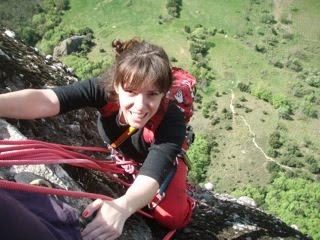
And myself keeping up the red tradition, with a monestary half way down the wall in front:

In a nutshell - Greece is definitely worth putting on any climber's map - for sport or long route climbing.
Kalymnos - Last Days
Our journey through the rock walls of Kalymnos continued with more days, more sectors, and more routes. After the impressive Cicati Cave, we spent another day at Ghost kitchen, where I managed to do the first 7a onsight of the trip - Axium, maybe an easy grading for once. The other routes were not that easy though, and both 7a and 7b to the right of Axium remained only as tries, and routes worth coming back to. Below myself working out the start of Thimari, supposedly 7a, but felt harder in the burning sun:

After a due rest day, we spent 2 days at Odyssey. It is a less impressive sector, with more 'usual' limestone pockets - reminding me of Camarasa and my struggles with Maugli there last fall. This time i struggled with another 7b that kept pushing me off, the Daphne. A technical line on almost whitish stone, with good rests and slippery sections in between, it motivated me to give it 3 tries, despite the burning and crushing the route offered to my tired fingers. Nevertheless, it went on the first try, next day, making it one and only project accomplished of this trip. Below myself being lowered, Pau and Luis below, and the endless Greek islands in the background, picture by Ioulietta.

And an incredible picture of Pau (by Ioulietta, again and always) has to appear here as well. He is climbing Amphora, 7b, another climb worth getting on soon before it gets too polished:

The last day of the trip we went to yet another sector - the powerful Spartacus. Another cave, tufas were waiting there for us, to leave a good taste in the mouth and a strong desire to come back to this enchanting place, and maybe work Spartacus or Gladiator routes there. Below myself on top of Amazonas tufa, hard for a 6c:

And i managed my best onsight of the trip - a real 7a this time, pumpy pockety Kerberus:

Kalymnos surprised me and went above my expectations in many ways - especially with the quality of routes, but also the beauty of the lanscape and the sea. It was also much less commercial than i expected. For instance, the approach and climbing at Cicati is very rewarding for the solitary ramblers looking for the wonders of this world. Kalymnos also confirmed my change from an alpine to a pure sport climber - i realized how much i really enjoy this sport, pushing my limit on the rock. Hopefully, i will come back - and thanks to the team for a great climbing vacation!!

After a due rest day, we spent 2 days at Odyssey. It is a less impressive sector, with more 'usual' limestone pockets - reminding me of Camarasa and my struggles with Maugli there last fall. This time i struggled with another 7b that kept pushing me off, the Daphne. A technical line on almost whitish stone, with good rests and slippery sections in between, it motivated me to give it 3 tries, despite the burning and crushing the route offered to my tired fingers. Nevertheless, it went on the first try, next day, making it one and only project accomplished of this trip. Below myself being lowered, Pau and Luis below, and the endless Greek islands in the background, picture by Ioulietta.

And an incredible picture of Pau (by Ioulietta, again and always) has to appear here as well. He is climbing Amphora, 7b, another climb worth getting on soon before it gets too polished:

The last day of the trip we went to yet another sector - the powerful Spartacus. Another cave, tufas were waiting there for us, to leave a good taste in the mouth and a strong desire to come back to this enchanting place, and maybe work Spartacus or Gladiator routes there. Below myself on top of Amazonas tufa, hard for a 6c:

And i managed my best onsight of the trip - a real 7a this time, pumpy pockety Kerberus:

Kalymnos surprised me and went above my expectations in many ways - especially with the quality of routes, but also the beauty of the lanscape and the sea. It was also much less commercial than i expected. For instance, the approach and climbing at Cicati is very rewarding for the solitary ramblers looking for the wonders of this world. Kalymnos also confirmed my change from an alpine to a pure sport climber - i realized how much i really enjoy this sport, pushing my limit on the rock. Hopefully, i will come back - and thanks to the team for a great climbing vacation!!
Tuesday, March 30, 2010
Kalymnos - Cicati Cave
Kalymnos developed originally as the sponge divers' island, but due to the desease that dessimated the animals in the 80ies, the island had to focus more on tourism.

(Climber as part of the tufas, Lolita 7a perfectly executed by Pau)
Rock climbing has become one of the niches for generating tourism revenues. By now Kalymnos is a well-known and popular destination with the worldwide climbing community. Its barren landscapes remind me a lot of Callanques, another Mediterranean jewel for some reason less popular with climbers lately, but full of incredible routes and adventures for the willing and courageous ones as well.
We have continued our experience at Kalymnos with a trip to Cicati cave. This required renting motos (a perfect advertisement for moto journey around the island below):

After a drive and a hike we arrived to this strange formation, where apparently a roof collapsed over an old cave, making it an open-sky wonder full of tufas, over 50 meters high and far from a fully developed climbing potential. The Cicati Cave, where capturing with a camera all its beauty remains a challenge:

We concentrated on a route opened by Andrada, called Lolita. It became the first project of the trip, to go at the second try despite some promising distance between the bolts. The climbing here is pretty exagerated in many respects. The tufas give a 3D feeling to the moves, and body has to be placed in all credible and incredible positions during the climb. It is very interesting to figure it out, actually a joy to jump monkey-like from tufa to another tufa. Below myself redpointing la Lolita, the crux of the route:

Monday, March 29, 2010
Kalymnos - First Days

The journey from Barcelona to Kalymnos has been a painful one and took us over 30 hours and all possible means of transport. Due to some strange planning, we first flew to Dusseldorf, than to Athens, took a ferry to Kos island, than a small boat to Kalymnos, and a couple of taxis in between. Tired but excited, we finally saw the island - from Kos, before taking the last boat:

Nevertheless, having left Barcelonan Saturday morning, we were already climbing by the afternoon of Sunday. The happy crew sitting at Grande Grota, one of the most impressive and easily accessed sectors of the island, below - Pau, Ioulietta, Luis:

The climbing started strong, with a couple of warm-ups at Panorama, and then the end of the day at overhangs of Grande Grota on the left. The overhangs and the tufas are just incredible. Below is myself finishing the hard work on Trela, incredible 7a of 40 meters tufa pulling:

The sunset at Telendos to end the day:

To be continued...
Thursday, March 25, 2010
US classics
Old good Tom Waits, an incredible guy, my dad has sent me the link to this fabulous performance:
Edna Million in a drop dead suit
Dutch pink on a downtown train
Two dollar pistol but the gun won't shoot
I'm in the corner in the pouring rain
16 men on a deadman's chest
And I've been drinking from a broken cup
2 pairs of pants and a mohair vest
I'm full of bourbon; I can't stand up.
Hey little bird, fly away home
Your house is on the fire; your children all alone
Hey little bird, fly away home
Your house is on the fire; your children all alone
Schiffer broke a bottle on Morgan's head
And I've been stepping on the devil's tail
Across the stripes of a full moon's head
Through the bars of a Cuban jail
Bloody fingers on a purple knife
A flamingo drinking from a coctail glass
I'm on the lawn with somebody else's wife
Come admire the view from up on top of the mast
Hey little bird, fly away home
Your house is on the fire; your children all alone
Hey little bird, fly away home
Yellow sheets in a Hong Kong bed Stazybo horn and a Slingerland ride
To the carnival is what she said
A hundred dollars makes it dark inside
And from Waits' early years, made me think of a good friend of mine who used to sing, although i don't know if he still sings like he used to.
Edna Million in a drop dead suit
Dutch pink on a downtown train
Two dollar pistol but the gun won't shoot
I'm in the corner in the pouring rain
16 men on a deadman's chest
And I've been drinking from a broken cup
2 pairs of pants and a mohair vest
I'm full of bourbon; I can't stand up.
Hey little bird, fly away home
Your house is on the fire; your children all alone
Hey little bird, fly away home
Your house is on the fire; your children all alone
Schiffer broke a bottle on Morgan's head
And I've been stepping on the devil's tail
Across the stripes of a full moon's head
Through the bars of a Cuban jail
Bloody fingers on a purple knife
A flamingo drinking from a coctail glass
I'm on the lawn with somebody else's wife
Come admire the view from up on top of the mast
Hey little bird, fly away home
Your house is on the fire; your children all alone
Hey little bird, fly away home
Yellow sheets in a Hong Kong bed Stazybo horn and a Slingerland ride
To the carnival is what she said
A hundred dollars makes it dark inside
And from Waits' early years, made me think of a good friend of mine who used to sing, although i don't know if he still sings like he used to.
Wednesday, March 24, 2010
re- Sant Benet
Sant Benet remains this special, mystic place. It is not that evident to feel the mystic nature of the place in just one visit though. One remains with some strange taste in the mouth - wondering what the whole fuss is about. Conglomerate routes, move after move, bolts - nothing special, the usual routine of going up, down, belaying, getting the draws, pushing a little bit harder. And then one day you go down and you realize it was all as if in a dream, in a separate reality, in the mist that so often covers the monastery and its bells - but not the Agujas on top, not the St Benet top of this Mother Mountain, the Mont Serrat.
Does Mont Serrat mean closed mountain? I don't know, but St Benet feels closed, separate, illusive. It is on the opposite spectrum from the noisy Margalef, the crowds, the vans, the stars and the paparazzi following the grown-ups or the children sending those projects, ticking down the lines, climbing numbers, not walls, doing sends, not routes. St Benet does not let you touch it that easily, it does not open itself to your inflated ego - you can be a weekend warrior climbing 5s or an experienced project-sender working 8bs, you can still be insured to fail at some 'warm-up' 6as at the Totxos sector. If not the one to the left, it will be the one to the right that will get to you. But St Benet is not only about humbling down the ego, or about good bouldering. It is all that and much more.
You have to pass one of those days there, climbing up the stairs, out of the mist, into the sun. Seeing the crazy goats soloing some of your projects, deciphering the codes left in many ermitas, hidden amongst the needles labyrinth, or just contemplating frogs and wondering about time. It is all St Benet, it is all there. Come, grab a project, do it, and go down. But a part of you will stay - sooner or later you come to realize that a part of you has remained in those strange shadows, in the curving line of the horizon, embracing that last foothold you dismissed so quickly. The dreamcatcher, the convoluted dreamcatcher set in stone. That is St Benet.


Despite my resounding and ambitious plans to "try the last three routes on the right this winter" i have only managed to climb Crit de Crim this spring - but as my friend says, climbing in St Benet is not like climbing in any other place. You do not send another 7a and forget about it. No, you climb Crit de Crim, a route formed by thousands of years of sea washing the rock, bringing it down, stone by stone, from the mountains of Mallorca, of Pireneu, or maybe even from the far-away Alps. It has been there, it will remain there - and we are passing through, engaging in the physical contact with this incredible, time-worn temple. Will the contact help us understand, help us finally be at peace? Or will it remain the dream?
Does Mont Serrat mean closed mountain? I don't know, but St Benet feels closed, separate, illusive. It is on the opposite spectrum from the noisy Margalef, the crowds, the vans, the stars and the paparazzi following the grown-ups or the children sending those projects, ticking down the lines, climbing numbers, not walls, doing sends, not routes. St Benet does not let you touch it that easily, it does not open itself to your inflated ego - you can be a weekend warrior climbing 5s or an experienced project-sender working 8bs, you can still be insured to fail at some 'warm-up' 6as at the Totxos sector. If not the one to the left, it will be the one to the right that will get to you. But St Benet is not only about humbling down the ego, or about good bouldering. It is all that and much more.
You have to pass one of those days there, climbing up the stairs, out of the mist, into the sun. Seeing the crazy goats soloing some of your projects, deciphering the codes left in many ermitas, hidden amongst the needles labyrinth, or just contemplating frogs and wondering about time. It is all St Benet, it is all there. Come, grab a project, do it, and go down. But a part of you will stay - sooner or later you come to realize that a part of you has remained in those strange shadows, in the curving line of the horizon, embracing that last foothold you dismissed so quickly. The dreamcatcher, the convoluted dreamcatcher set in stone. That is St Benet.

Iripi piripa showing its powers to the loyal follower in the middle of the sky...

And myself fighting for Crit de Crim on another strange, cold, and auspiciously dark winter day in the middle of spring...
Despite my resounding and ambitious plans to "try the last three routes on the right this winter" i have only managed to climb Crit de Crim this spring - but as my friend says, climbing in St Benet is not like climbing in any other place. You do not send another 7a and forget about it. No, you climb Crit de Crim, a route formed by thousands of years of sea washing the rock, bringing it down, stone by stone, from the mountains of Mallorca, of Pireneu, or maybe even from the far-away Alps. It has been there, it will remain there - and we are passing through, engaging in the physical contact with this incredible, time-worn temple. Will the contact help us understand, help us finally be at peace? Or will it remain the dream?
Monday, March 15, 2010
Update
Too many things have been going on lately and i have been pretty lazy with my blog. I will try to do a quick update about the past weeks as the time constraints remain very vivid during these cold spring times.
First of all - Margalef.
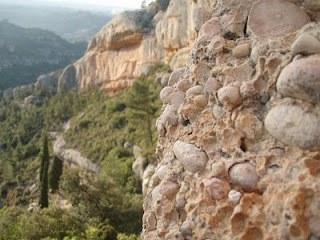
The picture above is from another sector i have recently discovered there - Cabernet, looking down at the Cami de la Ermita. Cabernet is the opposite of Laboratori - the other famous sector of Margalef full of famous routes, where one usually can see Sharma, Pou, and their paparazzi friends. Whereas Laboratori is full of short bouldery mono routes close to the road in a rather claustrophobic canyon, Cabernet is long, sustained, and open to the winds of time. The view is one of the best around Margalef, down the valley and up to the sun. Lonely climbers can sleep at the old abandoned Ermita, or sit around a friendly fire if others are around.
And the routes are incredible. Two projects remain there for me - Califato Coach (what Pau calls the little sister to Rambla), a long, sustained, and overhanging one, and the short bouldery Mar de Fons below. Both are rated 7b, but are very different in style and project approach needed. Like the Catalans say, I have feina there!!!

Above is the picture from the inspiring Klaas Willems, working on Pais de Monos, a neighboring 8a+ in Cabernet, a project for future days maybe, when my fingers will grow stronger..!
Second, Montserrat. We have been going back to the Mother Mountain lately and it is as good as ever - despite the cold times, the snowy times, the sad unsunny and happy sunny days. Several good days have seen us around the walls of Vermeil and Cova de Arcada - some projects went down, some others remain, and some rap rings are left to the more skillful climbers as bounty on a couple more 7as that i was not able to finish. That is the circle of life, and the Mother Mountain remains immortal.

Above picture by Remi, myself working hard to lead the awesome line of Vox Populi, a 7b to the right of Ultravox - another pending project in the gold mine of Montserrat Sur sport climbing.
And third - the skiing.

I managed to get out for 2 days to Deux Alpes, and benefit from incredible sunny weather and family times there. Skiing remains good, i got a chance to have some reminiscences from my past ski touring days. Yes, it was good - and maybe sometime in the future i will use my old skis again...Not this season though!

First of all - Margalef.

The picture above is from another sector i have recently discovered there - Cabernet, looking down at the Cami de la Ermita. Cabernet is the opposite of Laboratori - the other famous sector of Margalef full of famous routes, where one usually can see Sharma, Pou, and their paparazzi friends. Whereas Laboratori is full of short bouldery mono routes close to the road in a rather claustrophobic canyon, Cabernet is long, sustained, and open to the winds of time. The view is one of the best around Margalef, down the valley and up to the sun. Lonely climbers can sleep at the old abandoned Ermita, or sit around a friendly fire if others are around.
And the routes are incredible. Two projects remain there for me - Califato Coach (what Pau calls the little sister to Rambla), a long, sustained, and overhanging one, and the short bouldery Mar de Fons below. Both are rated 7b, but are very different in style and project approach needed. Like the Catalans say, I have feina there!!!

Above is the picture from the inspiring Klaas Willems, working on Pais de Monos, a neighboring 8a+ in Cabernet, a project for future days maybe, when my fingers will grow stronger..!
Second, Montserrat. We have been going back to the Mother Mountain lately and it is as good as ever - despite the cold times, the snowy times, the sad unsunny and happy sunny days. Several good days have seen us around the walls of Vermeil and Cova de Arcada - some projects went down, some others remain, and some rap rings are left to the more skillful climbers as bounty on a couple more 7as that i was not able to finish. That is the circle of life, and the Mother Mountain remains immortal.

Above picture by Remi, myself working hard to lead the awesome line of Vox Populi, a 7b to the right of Ultravox - another pending project in the gold mine of Montserrat Sur sport climbing.
And third - the skiing.

I managed to get out for 2 days to Deux Alpes, and benefit from incredible sunny weather and family times there. Skiing remains good, i got a chance to have some reminiscences from my past ski touring days. Yes, it was good - and maybe sometime in the future i will use my old skis again...Not this season though!

Wednesday, March 03, 2010
Globalization?

As a child I lived near this machine for quite some time, spending many of my summers with my grandmothers. My great-grand mother would start sewing, and i would play low down, close to the ground, with the pedal - if you sat on one side, it would start moving, and eventually shift underneath my weight. Then there were the letters, the imposing metal structure, the serious black color inspiring respect and consideration.
The interesting part of this story is that all this was happening during 1980s, in the middle of nowhere in the heart of Ukrainian Carpaty, the mountains where Drakula is supposed to have erected his castle in the neighboring Romania - or more prosaically a rather poor, systemically under-developed province of the already chronically lagging Galicia, part of the Western Ukraine. So what this 130-year old machine, invented in 1850 in the US was doing at 1500m, in the house of my great-grand mother, 1 hour walk from any road, and many hours away from what one could potentially call civilization??
To make any sense of this memory of mine one has to first realize that Western Ukraine used to be part of Austro-Hungarian empire before joining Poland after WWI, and finally 'joining' again the Soviet Union for the lack of a better option, or should i say alternative, after WWII. The family of my great-grandmother, wealthy farmers at the time, bought the Singer as the sign of the upcoming prosperity and technological progress of the brave new world. They were convinced by one of the representatives of the great American multinational, the Singer company, that happened to ramble into this far-away land inhabited by strange Hutsuls. Globalization was knocking at their door, it was the end of the 19th century, the glorious days of infinite progress and unlimited hope.
As a child, I would hear stories about how my great-grandma had run across the village to save the Singer, the only possession left, before, and then after another bombing, after another invasion, by another army, of enemies or friends, to have crossed the mountains again.
Sometimes, people go - but things stay. Now the Singer has moved again, to Belgium, to another lonely, cold and humid place. It remains - an American invention in the midst of the crazy complex world of ours, the symbol of globalization, for me the symbol of my youth, of my grandma and great-grandma, of the freedom and running across the mountain, of making my first steps in the vicinity of the machine. Technology - always present, but only us, humans, can make it valuable.
***************
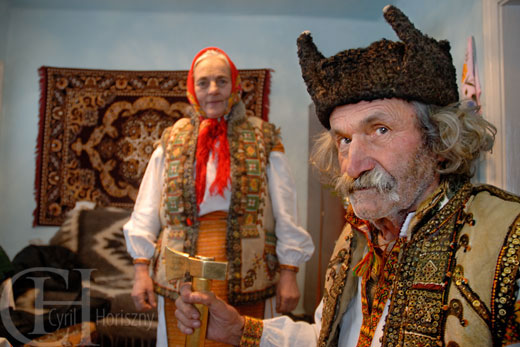
This is how I imagine my great-great grand father, just after he bought the Singer...picture by Kyrylo Horiszny.
******
"Waiting For The Miracle"
Baby, I've been waiting,
I've been waiting night and day.
I didn't see the time,
I waited half my life away.
There were lots of invitations
and I know you sent me some,
but I was waiting
for the miracle, for the miracle to come.
I know you really loved me.
but, you see, my hands were tied.
I know it must have hurt you,
it must have hurt your pride
to have to stand beneath my window
with your bugle and your drum,
and me I'm up there waiting
for the miracle, for the miracle to come.
Ah I don't believe you'd like it,
You wouldn't like it here.
There ain't no entertainment
and the judgements are severe.
The Maestro says it's Mozart
but it sounds like bubble gum
when you're waiting
for the miracle, for the miracle to come.
Waiting for the miracle
There's nothing left to do.
I haven't been this happy
since the end of World War II.
Nothing left to do
when you know that you've been taken.
Nothing left to do
when you're begging for a crumb
Nothing left to do
when you've got to go on waiting
waiting for the miracle to come.
I dreamed about you, baby.
It was just the other night.
Most of you was naked
Ah but some of you was light.
The sands of time were falling
from your fingers and your thumb,
and you were waiting
for the miracle, for the miracle to come
Ah baby, let's get married,
we've been alone too long.
Let's be alone together.
Let's see if we're that strong.
Yeah let's do something crazy,
something absolutely wrong
while we're waiting
for the miracle, for the miracle to come.
Nothing left to do ...
When you've fallen on the highway
and you're lying in the rain,
and they ask you how you're doing
of course you'll say you can't complain --
If you're squeezed for information,
that's when you've got to play it dumb:
You just say you're out there waiting
for the miracle, for the miracle to come.
Baby, I've been waiting,
I've been waiting night and day.
I didn't see the time,
I waited half my life away.
There were lots of invitations
and I know you sent me some,
but I was waiting
for the miracle, for the miracle to come.
I know you really loved me.
but, you see, my hands were tied.
I know it must have hurt you,
it must have hurt your pride
to have to stand beneath my window
with your bugle and your drum,
and me I'm up there waiting
for the miracle, for the miracle to come.
Ah I don't believe you'd like it,
You wouldn't like it here.
There ain't no entertainment
and the judgements are severe.
The Maestro says it's Mozart
but it sounds like bubble gum
when you're waiting
for the miracle, for the miracle to come.
Waiting for the miracle
There's nothing left to do.
I haven't been this happy
since the end of World War II.
Nothing left to do
when you know that you've been taken.
Nothing left to do
when you're begging for a crumb
Nothing left to do
when you've got to go on waiting
waiting for the miracle to come.
I dreamed about you, baby.
It was just the other night.
Most of you was naked
Ah but some of you was light.
The sands of time were falling
from your fingers and your thumb,
and you were waiting
for the miracle, for the miracle to come
Ah baby, let's get married,
we've been alone too long.
Let's be alone together.
Let's see if we're that strong.
Yeah let's do something crazy,
something absolutely wrong
while we're waiting
for the miracle, for the miracle to come.
Nothing left to do ...
When you've fallen on the highway
and you're lying in the rain,
and they ask you how you're doing
of course you'll say you can't complain --
If you're squeezed for information,
that's when you've got to play it dumb:
You just say you're out there waiting
for the miracle, for the miracle to come.
Sunday, February 21, 2010
Wishing for a star
Some wishing going on from a frustrated climber going through a hangover and reading others' positive posts (i.e. Tufa Tufa):
- strong head to be able to reach anchors on 7As
- strong fingers to be able to pull on one-finger pockets as a younger and desperate sister to Iker Pou
- inspiring projects to keep hungry
- and...as my friend Pau says, K SE ACABE EL PUTO FRIO !!! (let's be done with the cold...)
Thursday, February 18, 2010
Tribute to Jefferson Airplane
After Janis Joplin,

Jefferson Airplane seems an adequate next step. They are surprisingly good, and fresh, and .. relevant!

Jefferson Airplane seems an adequate next step. They are surprisingly good, and fresh, and .. relevant!
Subscribe to:
Posts (Atom)